What is Giftedness?
Giftedness refers to exceptional ability or potential in one or more domains such as intellectual reasoning, creativity, leadership, or specific academic fields. Modern theories of giftedness emphasize that it is not limited to high IQ alone but includes a combination of cognitive abilities, motivation, creativity, and environmental influences.
Joseph Renzulli’s Three-Ring Conception of Giftedness describes gifted behavior as the interaction of three clusters of traits: above-average ability, creativity, and task commitment. Together, these characteristics allow individuals to generate original ideas and high-level work.
Similarly, François Gagné’s Differentiated Model of Giftedness and Talent (DMGT) distinguishes between natural abilities (“giftedness”) and systematically developed skills (“talent”), emphasizing that environmental factors, opportunity, and effort play important roles in talent development.
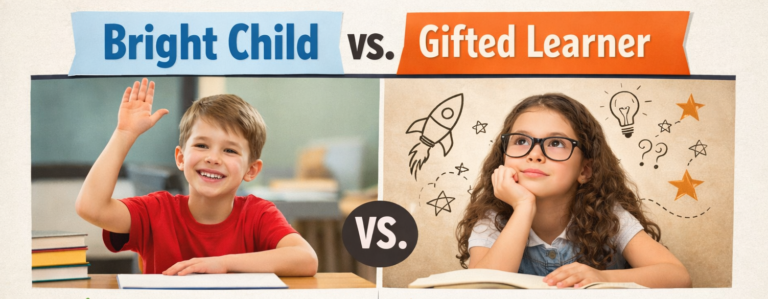
Gifted children often learn faster, think more abstractly, and demonstrate heightened curiosity compared to their peers. However, these abilities also come with unique developmental needs that may not always be supported in traditional classroom settings.
Characteristics of Gifted Learners
Research in gifted education has identified common cognitive, creative, and socio-emotional characteristics among gifted individuals.
Cognitive Characteristics
Gifted learners often demonstrate:
- Rapid acquisition of knowledge
- Advanced vocabulary and early reading ability
- Strong pattern recognition and abstract reasoning
- Intense curiosity and questioning
- Ability to synthesize complex ideas
These learners frequently require accelerated pacing or differentiated instruction to remain intellectually engaged.
Creative Characteristics
Gifted children frequently exhibit:
- Original and imaginative thinking
- Strong storytelling or artistic expression
- Ability to generate multiple solutions to problems
- Preference for open-ended exploration
Creativity is considered a key component of giftedness in many theoretical models.
Social and Emotional Characteristics
Gifted children may also display:
- Heightened sensitivity or empathy
- Strong moral awareness
- Preference for intellectual peers
- Deep passion for specific interests
Psychologist Linda Silverman describes many gifted children as exhibiting asynchronous development, where intellectual abilities advance more rapidly than emotional or social maturity.
Giftedness in the Philippine Context
In the Philippines, formal gifted education programs remain limited. Many gifted learners are educated within standard classroom environments where differentiated instruction may not always be available.
Research in education indicates that gifted students who are not appropriately challenged may experience:
- boredom or disengagement
- underachievement
- behavioral misinterpretations
- social isolation
Increasing awareness among educators and parents is therefore critical for identifying and nurturing gifted learners.
Organizations such as the Philippine Association for the Gifted aim to strengthen the ecosystem supporting gifted learners through advocacy, research dissemination, and community collaboration.
Why Gifted Education Matters
Gifted education focuses on developing exceptional potential through enriched learning experiences and appropriate educational opportunities.
Studies show that talent development programs can support long-term contributions in fields such as science, technology, arts, and leadership.
Supporting gifted learners is therefore not only an educational priority but also an investment in national human capital.
References
Gagné, F. (2004). Transforming gifts into talents: The DMGT as a developmental theory. High Ability Studies, 15(2), 119–147. https://doi.org/10.1080/1359813042000314682
National Association for Gifted Children. (2019). Redefining giftedness for a new century: Shifting the paradigm. Washington, DC: National Association for Gifted Children.
Renzulli, J. S. (1978). What makes giftedness? Reexamining a definition. Phi Delta Kappan, 60(3), 180–184, 261.
Silverman, L. K. (2013). Giftedness 101. New York, NY: Springer Publishing Company.
Subotnik, R. F., Olszewski-Kubilius, P., & Worrell, F. C. (2011). Rethinking giftedness and gifted education: A proposed direction forward based on psychological science. Psychological Science in the Public Interest, 12(1), 3–54. https://doi.org/10.1177/1529100611418056