A Parent Guide
Introduction
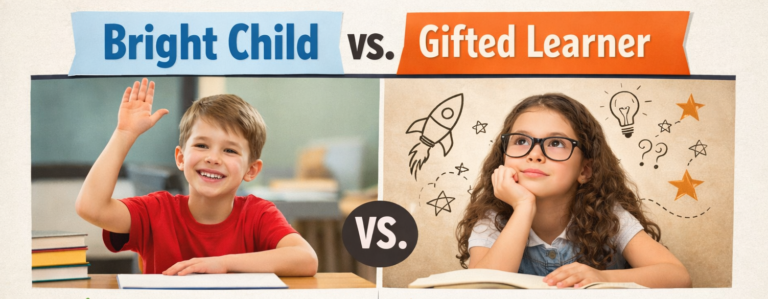
Many parents first notice that their child learns differently from other children of the same age. Some children read early, ask complex questions, or develop intense interests in specific topics.
These characteristics may be signs of giftedness, a term used to describe individuals who demonstrate exceptional ability or potential in one or more domains such as intellectual reasoning, creativity, leadership, or academic achievement.
Researchers emphasize that giftedness is not defined solely by high IQ scores, but by a constellation of abilities and traits that may develop at different rates.
Identifying giftedness early allows parents and educators to provide learning opportunities that support the child’s intellectual and emotional development.
Common Cognitive Signs of Giftedness
Gifted children often display advanced cognitive abilities compared with their peers. These may include:
- Early reading ability or strong interest in books
- Advanced vocabulary and complex language use
- Rapid learning and strong memory
- Ability to understand abstract ideas at a young age
- Deep curiosity and constant questioning
- Strong pattern recognition and problem-solving ability
Many gifted children enjoy exploring ideas in depth and may ask “why” or “how” questions that reflect sophisticated thinking.
Creative and Imaginative Traits
Creativity is an important component of many modern definitions of giftedness.
Some gifted children demonstrate:
- vivid imagination
- original ideas and unusual solutions to problems
- storytelling or artistic expression
- strong sense of humor
- ability to connect seemingly unrelated ideas
Creativity may appear in storytelling, drawing, building, music, or inventive play.
Social and Emotional Characteristics
Gifted children may also show distinctive emotional and social traits.
These can include:
- strong empathy and concern for fairness
- heightened emotional sensitivity
- preference for older peers or adults
- deep interest in moral or philosophical questions
- intense focus on specific interests
Psychologist Linda Silverman describes many gifted children as experiencing asynchronous development, meaning their intellectual abilities may be far ahead of their emotional or social maturity.
Intense Interests and Passion for Learning
Many gifted children develop deep interests in specific subjects.
Examples include:
- dinosaurs or animals
- space and astronomy
- mythology or fantasy stories
- mathematics or puzzles
- science experiments
These interests often involve sustained attention and a desire to gather large amounts of information about the topic.
Important Note: Gifted Children Do Not All Look the Same
Giftedness can manifest in many ways.
Some gifted children may:
- excel academically
- show creative talents rather than academic strengths
- appear bored or disengaged in school
- perform inconsistently despite strong ability
Because giftedness varies widely, formal assessment by qualified professionals may help clarify a child’s learning profile.
What Parents Can Do
If you believe your child may be gifted, consider the following steps:
Observe and document behaviors
Take note of learning patterns, interests, and developmental milestones.
Communicate with teachers
Teachers may provide insight into how the child learns in the classroom.
Encourage curiosity and exploration
Provide books, creative activities, and opportunities for deeper learning.
Consider professional evaluation if needed
Psychologists or specialists trained in cognitive assessment may help identify advanced abilities or learning differences.
References
Renzulli, J. S. (1978). What makes giftedness? Reexamining a definition. Phi Delta Kappan, 60(3), 180–184, 261.
Silverman, L. K. (2013). Giftedness 101. New York, NY: Springer Publishing Company.
Subotnik, R. F., Olszewski-Kubilius, P., & Worrell, F. C. (2011). Rethinking giftedness and gifted education: A proposed direction forward based on psychological science. Psychological Science in the Public Interest, 12(1), 3–54. https://doi.org/10.1177/1529100611418056
National Association for Gifted Children. (n.d.). What is giftedness? Washington, DC: National Association for Gifted Children. Retrieved from https://www.nagc.org/resources-publications/resources/what-giftedness
Further Reading
National Association for Gifted Children
https://www.nagc.org
Davidson Institute for Talent Development
https://www.davidsongifted.org
SENG (Supporting Emotional Needs of the Gifted)
https://www.sengifted.org
Hoagies’ Gifted Education Page
https://www.hoagiesgifted.org