What is Twice-Exceptionality?
Twice-exceptional (2e) learners are individuals who are both gifted and have one or more learning differences or neurodevelopmental conditions. These conditions may include ADHD, autism spectrum conditions, dyslexia, dysgraphia, or anxiety disorders.
The term “twice-exceptional” recognizes that these learners possess both exceptional strengths and significant challenges.
Because their abilities and difficulties coexist, they may not fit neatly within traditional educational categories.
The Challenge of Identification
Twice-exceptional students are often underidentified due to a phenomenon known as masking.
Masking occurs when:
- giftedness compensates for learning difficulties, or
- learning difficulties obscure gifted potential.
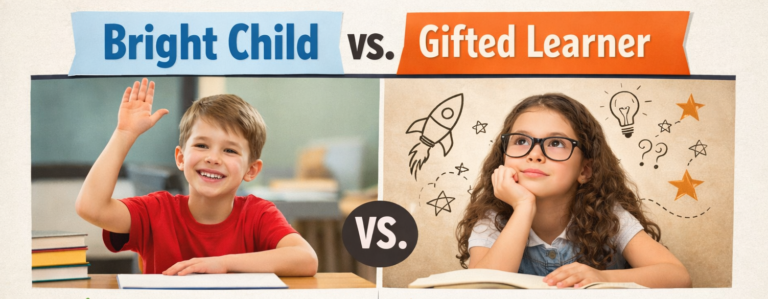
As a result, these learners may appear average or inconsistent in performance despite having exceptional cognitive abilities.
Researchers have found that 2e learners may experience frustration when educational environments focus primarily on deficits rather than strengths.
Characteristics of Twice-Exceptional Learners
Common patterns observed among twice-exceptional learners include:
- strong reasoning ability with inconsistent academic output
- advanced verbal ability paired with writing difficulties
- high creativity with attention regulation challenges
- intense interests combined with executive functioning struggles
Because these learners often demonstrate uneven development, they require educational approaches that simultaneously nurture their strengths and address their challenges.
Educational Approaches for 2e Learners
Research suggests that effective support for twice-exceptional learners includes:
Strength-Based Learning
Instruction should build upon the learner’s areas of talent and interest.
Appropriate Accommodations
Examples include assistive technology, alternative assessment formats, and organizational supports.
Collaboration
Successful support typically involves coordinated efforts between parents, educators, psychologists, and specialists.
Social and Emotional Support
Many 2e learners benefit from guidance that helps them understand both their abilities and their challenges.
The Role of Advocacy and Awareness
Increasing awareness of twice-exceptionality helps educators and parents recognize that high ability and learning challenges can coexist.
Advocacy organizations, educators, and specialists play a key role in promoting educational systems that support diverse learners, including those who are twice-exceptional.
References
Baum, S. M., Schader, R. M., & Owen, S. V. (2017). To be gifted and learning disabled: Strength-based strategies for helping twice-exceptional students with LD, ADHD, ASD, and more (3rd ed.). Waco, TX: Prufrock Press.
Foley-Nicpon, M., Allmon, A., Sieck, B., & Stinson, R. D. (2011). Empirical investigation of twice-exceptional students: Where have we been and where are we going? Gifted Child Quarterly, 55(1), 3–17. https://doi.org/10.1177/0016986210382575
National Association for Gifted Children. (2013). Twice-exceptional students: NAGC position statement. Washington, DC: National Association for Gifted Children.
Reis, S. M., Baum, S. M., & Burke, E. (2014). An operational definition of twice-exceptional learners: Implications and applications. Gifted Child Quarterly, 58(3), 217–230. https://doi.org/10.1177/0016986214534976